When God Calls Us to the Cold Streets
When God Calls Us to the Cold Streets
"A Reflection on Isaiah 58:7 and the Heart of God for the Unhoused"

There are verses in Scripture that whisper. And then there are verses that shake you awake.
Isaiah 58:7 is one of those verses.
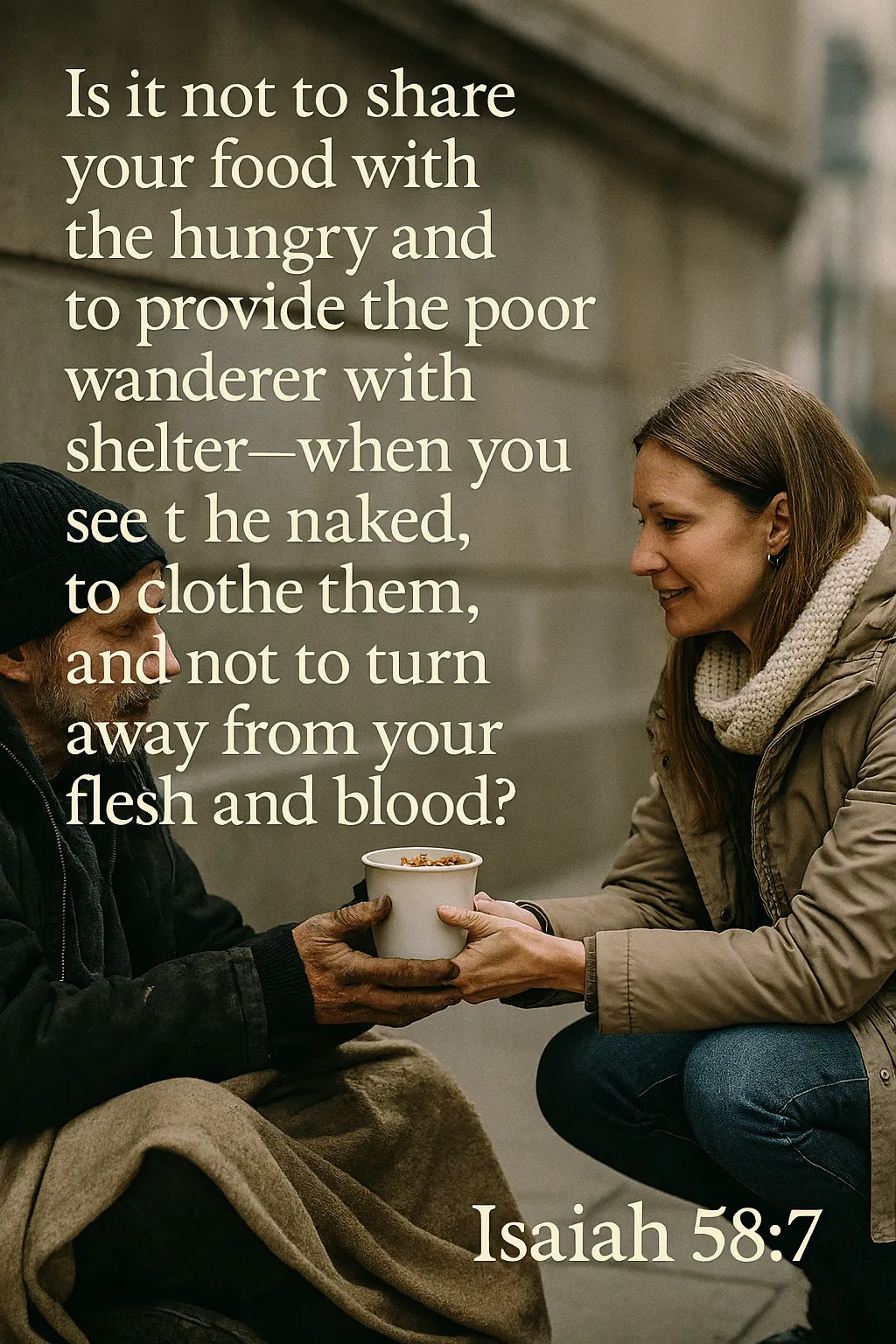
“Is it not to share your food with the hungry and to provide the poor wanderer with shelter— when you see the naked, to clothe them, and not to turn away from your own flesh and blood?”
This isn’t a suggestion. This isn’t a gentle nudge. This is God pulling back the curtain and saying, “This is what my heart looks like.”
The Gospel Was Never Meant to Stay Indoors
When Isaiah spoke these words, God was confronting a people who were very religious — they prayed, they fasted, they checked all the spiritual boxes. But their faith had become hollow. Their worship was polished, but their compassion was absent.
God’s message was simple and piercing:
If your worship doesn’t move you toward the hurting, it isn’t worship at all.
And today, the same truth stands.
We live in a world where thousands of our brothers and sisters sleep under bridges, in abandoned buildings, in tents, in cars, or on cold concrete. They are not statistics. They are not “the homeless.” They are people — image-bearers of God, carrying stories, trauma, hope, and heartbreak.
They are the ones Isaiah was talking about.
The Unhoused Are Not Invisible to God
When winter hits, the cold becomes a thief. It steals warmth. It steals dignity. It steals life.
But long before the temperature drops, many of our unhoused neighbors have already been robbed — of safety, of belonging, of family, of trust.
And yet, God sees them.
Not as burdens. Not as failures. Not as problems to be solved. But as His children.
Isaiah 58:7 reminds us that God’s people are called to see them too — not with pity, but with solidarity. Not with judgment, but with compassion. Not with distance, but with presence.
Compassion Is Not Charity — It’s Obedience
Isaiah doesn’t say, “If you feel like it…” He says, “Is it not to share… to provide… to clothe… to not turn away?”
This is the kind of faith that costs something.
It costs comfort. It costs time. It costs convenience. Sometimes it costs safety, reputation, or the approval of people who don’t understand why you care so much.
But this is the faith Jesus lived.
He touched the untouchable. He sat with the outcasts. He walked into the places polite society avoided. He didn’t turn away — He drew near.
And when we step into the cold, the alleys, the shelters, the encampments, the broken places… we are stepping into the very places where Jesus Himself would go.
The Streetlight of Hope in a Dark World
Every time you hand someone a blanket, a meal, a survival kit, or simply your presence, you are doing more than meeting a need — you are declaring a truth:
“You are not forgotten. You are not alone. You are loved by God.”
This is why ministries like Sanctuary Without Walls exist. Not to build bigger buildings, but to build bigger tables. Not to wait for people to come to us, but to go where they are. Not to preach at people, but to walk with them.
Isaiah 58 is not just a call to action — it’s a call to identity. This is who we are. This is what the Church was always meant to be.
When We Show Up, God Shows Up
The promise of Isaiah 58 is breathtaking. When we care for the poor, God says:
“Your light will break forth like the dawn.”
“Your healing will quickly appear.”
“The glory of the Lord will be your rear guard.”
In other words:
When we show up for the broken, God shows up for us.
Not as a reward, but as a natural overflow of living in alignment with His heart.
A Final Word

If Isaiah 58:7 teaches us anything, it’s this:
True faith is not measured by how loudly we worship, but by how deeply we love.
And love — real, Christ-shaped love — always moves toward the cold, the hungry, the wandering, the wounded.
May we be a people who refuse to turn away. May we be a people who step into the places others avoid. May we be a people who carry warmth into winter, hope into despair, and Jesus into the streets.
Because the unhoused are not “them.” They are us. Our flesh and blood. Our neighbors. Our responsibility. Our family.
And God has called us — clearly, unmistakably — to love them well.
